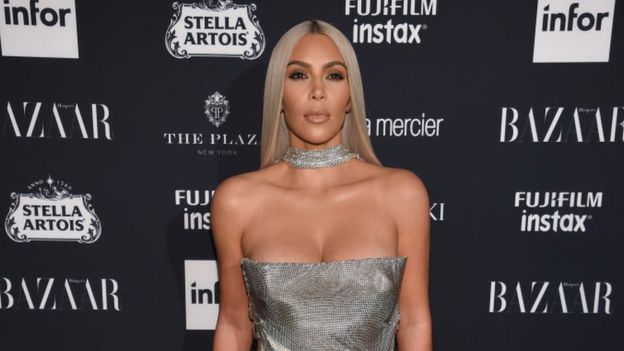
Kim Kardashian WestKim Kardashian West tweeted last year that she had made $80m (£62m) from her video game app.
Her latest project, ScreenShop, could see her add some serious cash to her tech empire as it's released worldwide.
The app, which lets social media users buy what they see in posts, is something Kardashian West says she has "never seen before".
It works on platforms like Instagram, Facebook and Snapchat by matching clothes you see on them to the exact items.
The reaction hasn't been entirely positive, though, with some bloggers afraid that the app will stop them from earning commission from sales via their own social media platforms.

ScreenShop also offers you cheaper alternatives because items on celebrities are likely to be designer or have high prices.
The app partners with company Farfetch to provide the technology to show copies and similar items.
This feature is something Kardashian West approves of. "I obviously want to invest my time in projects that I really think people would want and things I haven't seen before," she tells Vogue.
"Shoppers are so much more visual and so much more creative than maybe in the past.
"I truly think if they see something worn a certain way, if you market it that way and merchandise it that way in the store, people will buy it."Kim Kardashian West
Katie Baron, a fashion writer and global head of retail at Stylus Media Group, tells the BBC that Kardashian West's app "means serious business in an era where instant digital gratification is pretty much expected".
"It's not quite as seamless as the initial headline may suggest," she says. "You still need to take a screenshot, upload it, scour through the various options and then be redirected to a retail website to buy.
"But it's possibly one of the best tools to date for translating the power of social media, driven by a youth sector who talk a largely visual language, into cold hard cash.
"Brands, of course, just have to hope that these social media fashion fans don't always go for the budget option, or that there's a way within the app to surface their products. Without that, many brands will be left in the cold."
ScreenShop has struck commission deals with big name brands ASOS, Topshop, Boohoo and Forever 21.
These companies will provide a databases of items and better matches of clothes, but other retailers' items will still be featured as part of search results...
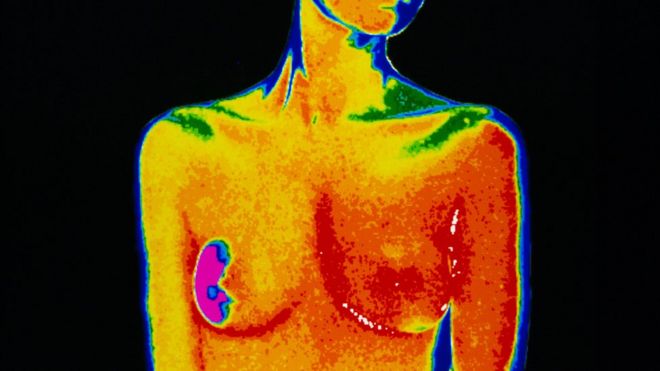
A scan of a woman with breast cancerBreast cancer can resurface after remaining dormant for 15 years following successful treatment, a study has found.
Women with large tumours and cancer that had spread to the lymph nodes had the highest 40% risk of it coming back.
Researchers writing in the New England Journal of Medicine said extending treatment with hormone therapy could reduce the risk of it recurring.
Scientists analysed the progress of 63,000 women for 20 years.
All had the most common form of breast cancer.
This is a type fuelled by the hormone oestrogen which can stimulate cancer cells to grow and divide.
Every patient received treatments such as tamoxifen or aromatase inhibitors which block the effects of oestrogen or shut off the hormone's supply.
Although after five years of treatment their cancers had gone, over the next 15 years a steady number of women found that their cancer spread throughout their body - some up to 20 years after diagnosis.
Women who originally had large tumours and cancer that had spread to four or more lymph nodes were at highest risk of the cancer returning the next 15 years, the study said.
Women with small, low-grade cancers and no spread to the lymph nodes had a much lower 10% risk of cancer spread over that time.

'Remarkable'

Lead researcher Dr Hongchao Pan, from University of Oxford, said: "It is remarkable that breast cancer can remain dormant for so long and then spread many years later, with this risk remaining the same year after year and still strongly related to the size of the original cancer and whether it had spread to the (lymph) nodes."
Doctors have long known that five years of tamoxifen reduces the risk of recurrence by about a third in the five years after stopping treatment.
Recent research has suggested that extending hormone therapy to 10 years may be more effective at preventing breast cancer recurrence and death.
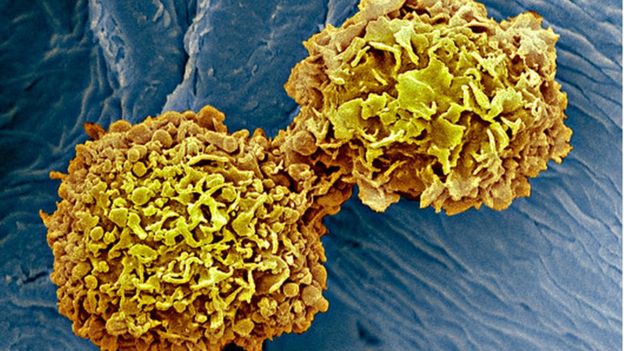
breast cancer cells

Aromatase inhibitors, which only work for post-menopausal women, are believed to be even more effective.
But there are side effects with hormone treatments which can affect patients' quality of life and cause them to stop taking the pills.
These include menopausal symptoms, osteporosis, joint pain and carpal tunnel syndrome.
Prof Arnie Purushotham, senior clinical adviser at Cancer Research UK, which funded the study, said that since the research began, new drugs had been used to treat breast cancer and those worked in different ways to tamoxifen.
He said: "It's vital that work continues to better predict which cancers might return.
"We also need to know what the difference for women might be in taking hormone therapies for 10 years instead of five, the side effects and how this affects patients' quality of life."
Sally Greenbook, from charity Breast Cancer Now, said it was essential that women discussed any changes in treatment with their doctor.
"We would urge all women who have had treatment for breast cancer not to be alarmed, but to ensure they are aware of the signs of recurrence and of metastatic breast cancer, and to speak to their GP or breast care team if they have any concerns."
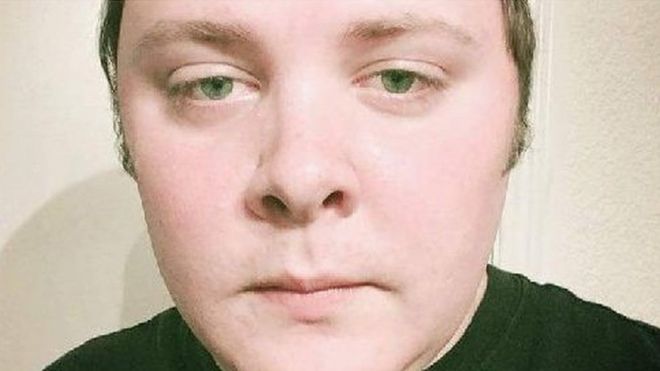
A picture of Devin Kelley taken from his deleted Facebook page
The ex-wife of Texas church gunman Devin Kelley has said he subjected her to abuse and violence, and threatened to kill her and her entire family.
Kelley "had a lot of demons or hatred inside of him", said Tessa Brennaman, 25, in an interview with CBS News.
The former US Air Force airman pleaded guilty in 2013 to hitting, choking and kicking Ms Brennaman, and to fracturing the skull of her young son.
He was sentenced to a year in military prison and demoted over the incident.
In her first interview since Kelley shot and killed 26 people at the First Baptist Church in Sutherland Springs, Texas on 5 November, Ms Brennaman described how he once threatened to kill her for getting a speeding ticket.
"He had a gun in his holster right here and he took that gun out and he put it to my temple and he told me, 'Do you want to die? Do you want to die?'" she said.


Kelley also wounded 20 people in the shooting. Outside the church, he dropped the military-style AR-15 rifle he used in the massacre and drove away from the scene in his truck, pursued by two bystanders, before shooting himself dead with a handgun.
Kelley had been banned from buying or owning a gun after his domestic violence conviction but his conviction "was not entered into the National Criminal Information Center database", the Air Force revealed in the wake of the shooting.
People with domestic violence convictions are barred from owning firearms, but laws, which vary from state to state, are beset by loopholes and lack of enforcement.
Gun safety campaign group Every Town For Gun Safety found that in 54% of the 156 mass shootings between 2009 and 2016, the victims were current or former intimate partners or other family members.
More than 50 women in the US every month are killed by former partners, according to data compiled by Everytown, and the presence of a gun in a domestic violence situation makes it five times more likely that a woman will be killed.

Devin Kelley's brushes with the law and the military

  • A series of legal troubles began in 2012 when he was court-martialled and sentenced to a year in military prison for assaulting his wife and child
  • In the same year Tessa Kelley filed court papers to divorce Kelley, with her wish being speedily granted. There were no children listed in the proceedings
  • After his jail term ended in 2014, Kelley was demoted in rank and released from the military with a bad conduct discharge
  • In August 2014 he again appeared in court - this time charged with mistreating, neglecting or being cruel to animals. The case was eventually dismissed
Hassan Nasrallah
The leader of Lebanon's Hezbollah has accused Saudi Arabia of declaring war on his country, days after Lebanese PM Saad al-Hariri announced his resignation in the Saudi capital.
Hassan Nasrallah said Saudi Arabia was holding Mr Hariri against his will.
He also accused the Saudis of inciting Israel against Lebanon.
The powerful Hezbollah Shia movement is an ally of Iran, which has been trading accusations with the Saudis of fuelling tension in Lebanon and the region.
Mr Hariri said in a TV broadcast from Riyadh on Saturday he was stepping down because of an unspecified threat to his life. He also attacked Hezbollah and Iran.
However, Lebanese President Michel Aoun and other senior politicians have demanded his return, amid suspicions that he is being held by the Saudis under house arrest and forced to do their bidding.
Mr Aoun has not accepted Mr Hariri's resignation.
Mr Hariri has still not spoken publicly since his announcement.

What did the Hezbollah leader say?

In a televised speech on Friday, Mr Nasrallah said Saudi Arabia was trying to provoke fighting amongst the Lebanese.
"In short, it is clear that Saudi Arabia and Saudi officials have declared war on Lebanon and on Hezbollah in Lebanon, but I have to say this is a war on Lebanon," he said.
Mr Nasrallah also accused Saudi Arabia of being prepared to pay "billions" to Israel for a military strike against Lebanon, describing this as the "most dangerous thing".
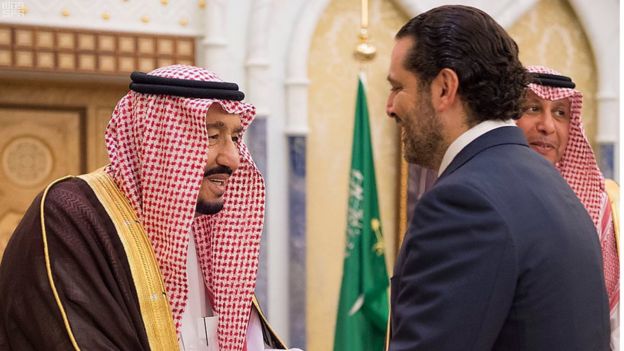
Mr Hariri (R) meets Saudi King Salman bin Abdulaziz al-Saud - 6 NovemberImage copyrightEPA
Image captionMr Hariri (R) was seen meeting the Saudi king on Monday
At the weekend the Hezbollah leader had said that Mr Hariri had been forced to resign by the Saudis, but he repeated the allegations on Friday, saying that this was now "beyond any doubt".
Saudi Arabia was attempting to remove Mr Hariri as prime minister and impose a new leadership on his political movement, he said.
BBC Middle East editor Sebastian Usher says Mr Nasrallah's words were delivered as calmly as ever - but they will inevitably raise the temperature further as a growing number of countries outside the region try to calm the crisis.

How has the international community reacted?

There are fears Lebanon could become embroiled in a wider regional confrontation between Saudi Arabia and Iran.
Tensions between the three countries have soared since Mr Hariri announced his resignation.
But US Secretary of State Rex Tillerson warned against Lebanon being used for a proxy conflict, adding that the US strongly backed Lebanon's independence.
UN Secretary General Antonio Guterres warned that a new conflict in the region would have "devastating consequences".
On Thursday, French President Emmanuel Macron paid an unscheduled visit to Saudi Arabia, to emphasise to Saudi leaders the importance of stability in Lebanon.
France has historical ties with Lebanon, as its former colonial power before it gained independence during World War Two.
Earlier on Thursday, Saudi Arabia and its Gulf allies told their citizens in Lebanon to leave the country immediately.
The move came after Riyadh accused Iran of "direct military aggression", saying it supplied a missile which it says was fired by Hezbollah at Riyadh from Yemen on Saturday.
Iran has dismissed the Saudi allegations as "false and dangerous".
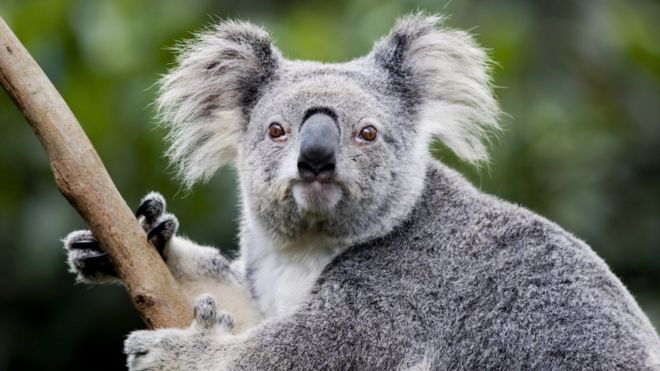
A generic image of a koala
A koala has been found dead with its ears cut off in Australia, amid what police say is a spate of cruelty cases involving native animals.
The marsupial was found on a road in Warrnambool, about 250km (150 miles) west of Melbourne, on Monday.
It is not clear whether the koala was alive when mutilated, authorities said.
Police described the case as "disturbing" and said it followed similar mutilations involving kangaroos and wallabies.
"There is no reason for anybody to wish to treat an animal in this way, whether alive or dead," said Sgt Pat Day, in a video posted by the Warrnambool Standard.
Police did not give details of other recent cruelty cases, but said no others had targeted a koala.
Koalas are native to Australia and classified as a "vulnerable" species. There are fewer than 100,000 left in the wild, according to the Australian Koala Foundation.
Police have appealed for help to find the perpetrator.